
TR-49 review
- 1 Comment

As compelling as it is confounding, inkle’s latest matches code-breaking mystery deduction with intriguing audio drama
You never quite know what you’re getting yourself into when you play an inkle game. It could be a spiritual language deciphering tale (Heaven’s Vault), a roguelite murder mystery with a twist (Overboard! and Expelled!) or a delightful romp through the Scottish scenery (A Highland Song) among others. TR-49 is quite unlike any of those, with scant details offered on exactly what kind of game it is beyond the knowledge that it was inspired by developer Jon Ingold’s late great-uncle, who had worked at Bletchley Park, the codebreaking home of the Bombe machine used to decipher Enigma code sent from Nazi Germany during WWII.
The story is that this same great-uncle had amassed some unusual electronic devices and diagrams alongside a stash of 50 books in his attic, for which the authors and titles no longer seem to exist in the public domain or in online searches. Instead, these books have been literally fed into a strange code-breaking machine to help us get to the bottom of the mystery behind them. One of the books had the stamp "TR-49"; hence the name of the game.
As it turns out, this is compelling detective fiction of a different kind than we’re used to, combining an addictive computer-based investigation process with an interesting if opaque plot with an audio edge. Think Sam Barlow’s Her Story, but with fragmented, often (initially) unintelligible text and audio cues instead of video clips. Fans of deduction mysteries will likely enjoy it a lot, with new details becoming harder to uncover as you progress further, motivated by that feeling of finding ‘just one more’ before you’re ready to call it a day.
Beware, though, that your neurons need to be furiously firing for some of the more obscure ‘clues,’ and you’ll need to keep your wits about you when it starts to feel like there’s too much going on. The cerebral TR-49 is not for the faint of mind, but it’s polished and intriguing, and scratches the completionist itch perfectly. The story doesn’t branch at all, but I played through this game twice because I had more than a few questions the first time and came away feeling that the ending in particular was rushed. The narrative, as mysterious as it was designed to be, ended up never feeling quite as fleshed out as it could have been. That being said, I had a lot of fun with the game, and with a few twists and turns scattered throughout, I felt rewarded when credits rolled both times.
I need to tread as carefully to respect the game’s overall mystery ethos, as I don’t want to give too much away. The cold opener confirms the fact that TR-49 is meant to be enjoyed with as little pre-information as possible. This may put off some players who like to go in forewarned about what to expect, but rest assured, for the most part the mechanics here are straightforward and although the game is definitely not linear, it feels sufficiently guided and you’ll soon start to get the hang of it.
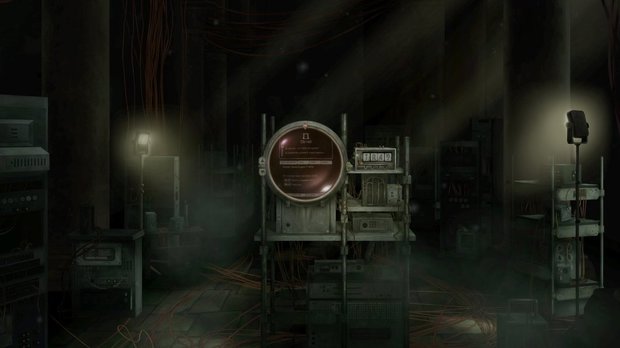
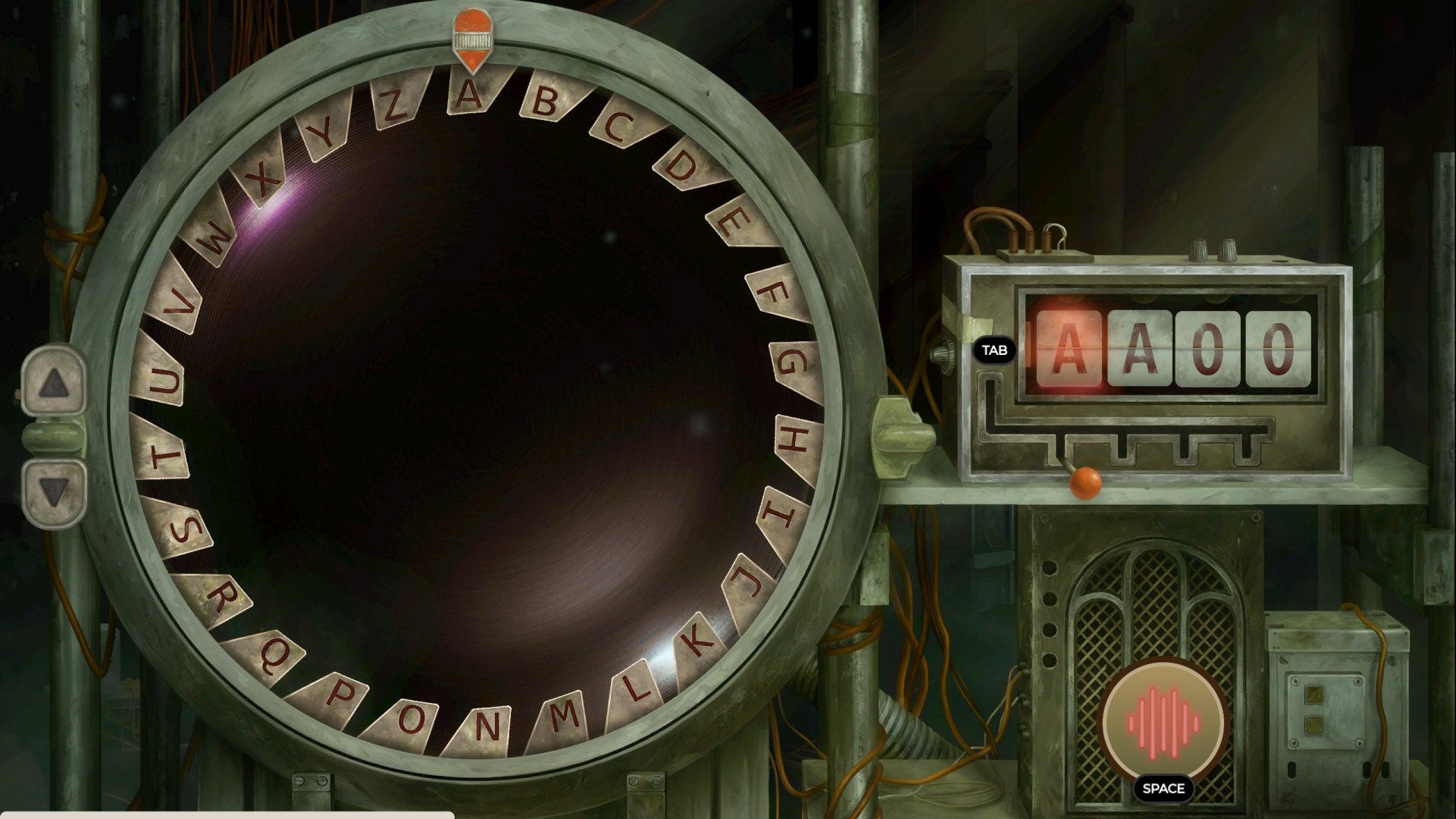
The story begins with a female voice quoting what seems to be a passage or poem from a book, in a very dark room. A male voice comes over an intercom, asking ‘Abbi, are you there?’ A prompt appears on the screen to press a button to answer the intercom. The male voice introduces himself as Liam and asks where Abbi thinks she is and what she can see. Abbi can’t see much (but thinks she’s in a cellar), and as Liam reroutes some power from wherever he is into the room, a strange machine comes into view. Abbi has absolutely no idea what it is, but it looks like it was created from an odd schematic, with a huge circular screen and a box next to it with four code input spaces available, two for letters and two for numbers.
Abbi continues a back and forth with Liam about what exactly she should be doing, which actually feels like one of the least pertinent questions one might ask at this specific time, but Liam is vague (of course!) and has an air of confidence in his reply: ‘I’ll explain everything later.’ Abbi must have the patience of a saint here because she is left staring at a blank screen. The title of the game offers the clue you need to what must be entered, and the machine whirrs to life. Liam sounds panicked, almost pleading with Abbi to tell him exactly what is going on – ‘It’s important’ – and urges Abbi to just click something.
It’s here that Liam explains that the device is a take on the Bombe machine, built to understand things that can’t be understood initially, devised mainly as a way to decipher German war codes but now used for ‘other things.’ The way it does this is, in Liam’s words, ‘by eating books.’ Abbi seems momentarily perturbed by this revelation but nevertheless is ready with her notebook, and as Liam wistfully comments that ‘you could get lost in this thing,’ Abbi is ready to investigate the ‘gibberish’ now displayed on this unusual machine’s screen and get to work. What work, you ask? Playing as Abbi, you must find a particular book hidden among the 50 that have been fed in – and that’s all you’re getting regarding the plot, as you’ll gradually uncover the history of the machine as you go along.
TR-49
| Genre: | Mystery |
|---|---|
| Presentation: | 2D or 2.5D, Slideshow |
| Theme: | Spy |
| Perspective: | First-Person |
| Graphic Style: | Illustrated realism |
| Gameplay: | Research, Deduction |
| Control: | Direct Control, Point-and-click |
| Game Length: | Medium (5-10 hours) |
| Difficulty: | High |
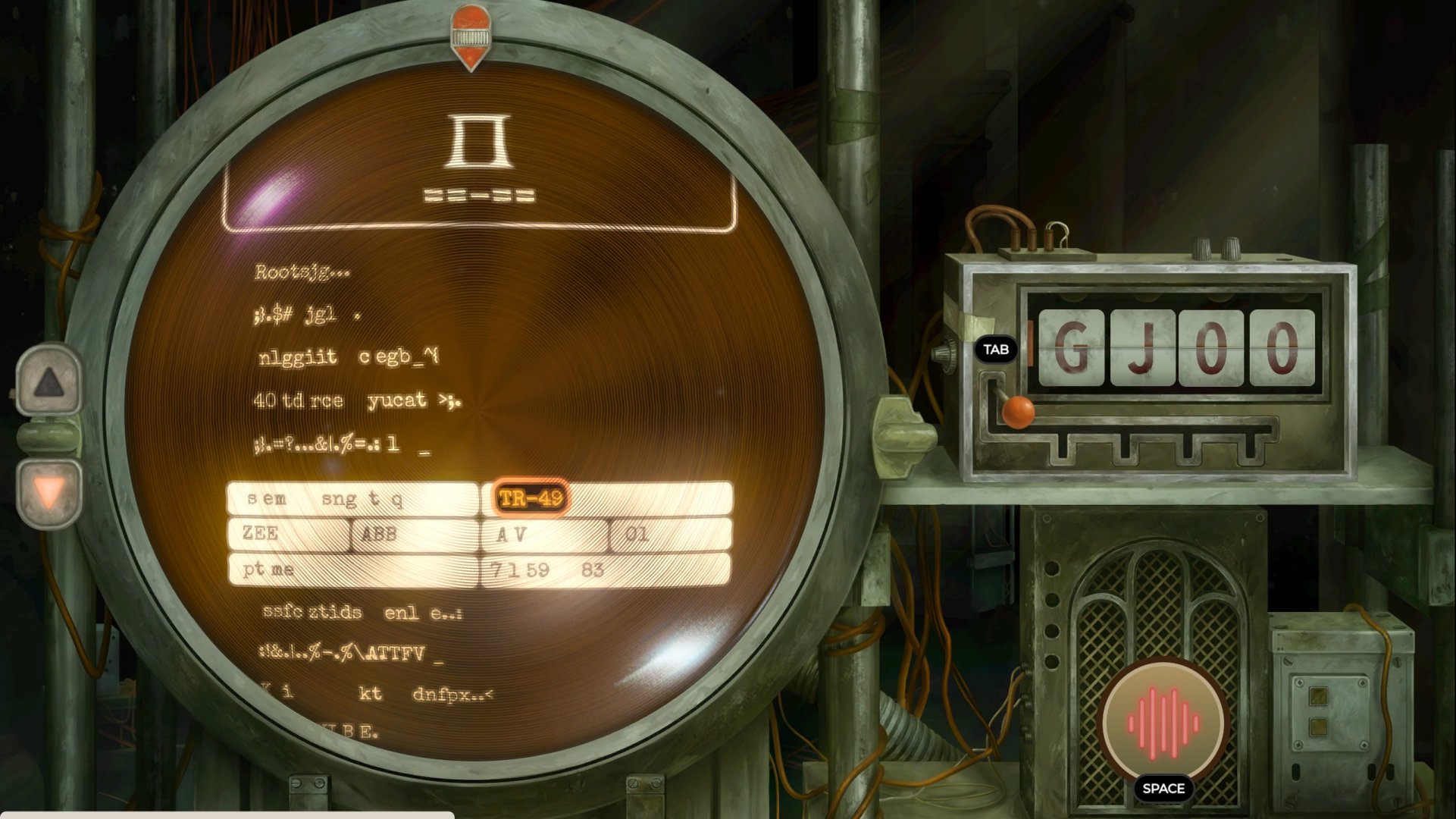
In a non-spoilery nutshell, each code you find highlighted or can deduce logically from the information available corresponds to a source – books, journals, even letters – hidden within the machine. Exploring a code by entering the correct sequence of two letters and two numbers could give Abbi the title of a book, an author, or more information on a title. Successfully entering a code makes the machine screen scroll through an unseen filing system to a specific, fragmented entry. Unfortunately, initially the text is scrambled, perhaps intentionally corrupted in some way. Digging through the text, some highlighted words may be ‘collected’ and added to the journal, and some partial codes may be clicked to transfer them over to the code input box. Before long you’ll begin to uncover source titles and authors, and once you’ve matched them to their associated codes, the garbled text will clear up at last, allowing you to read it properly, adding still more clues to pursue.
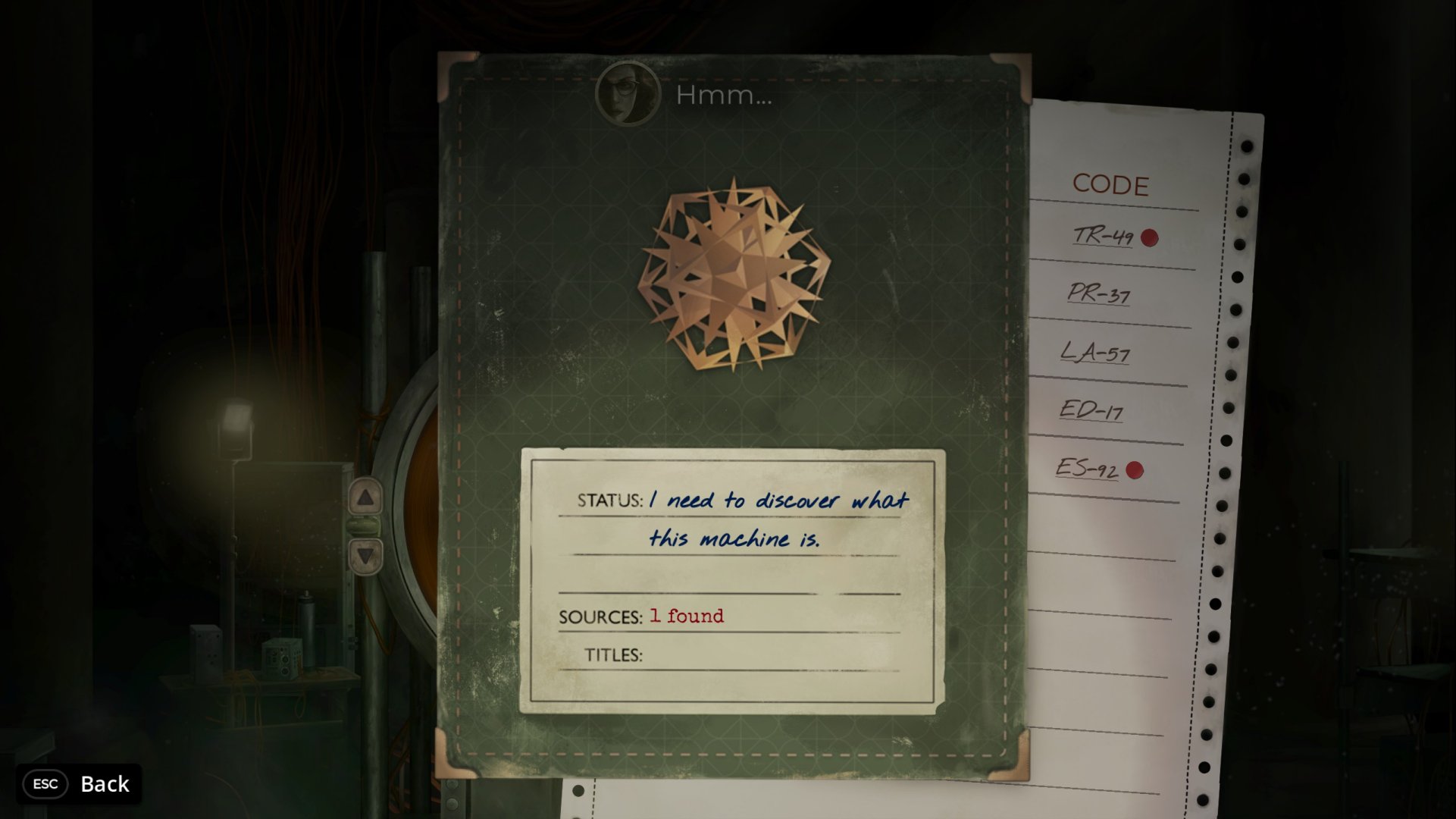
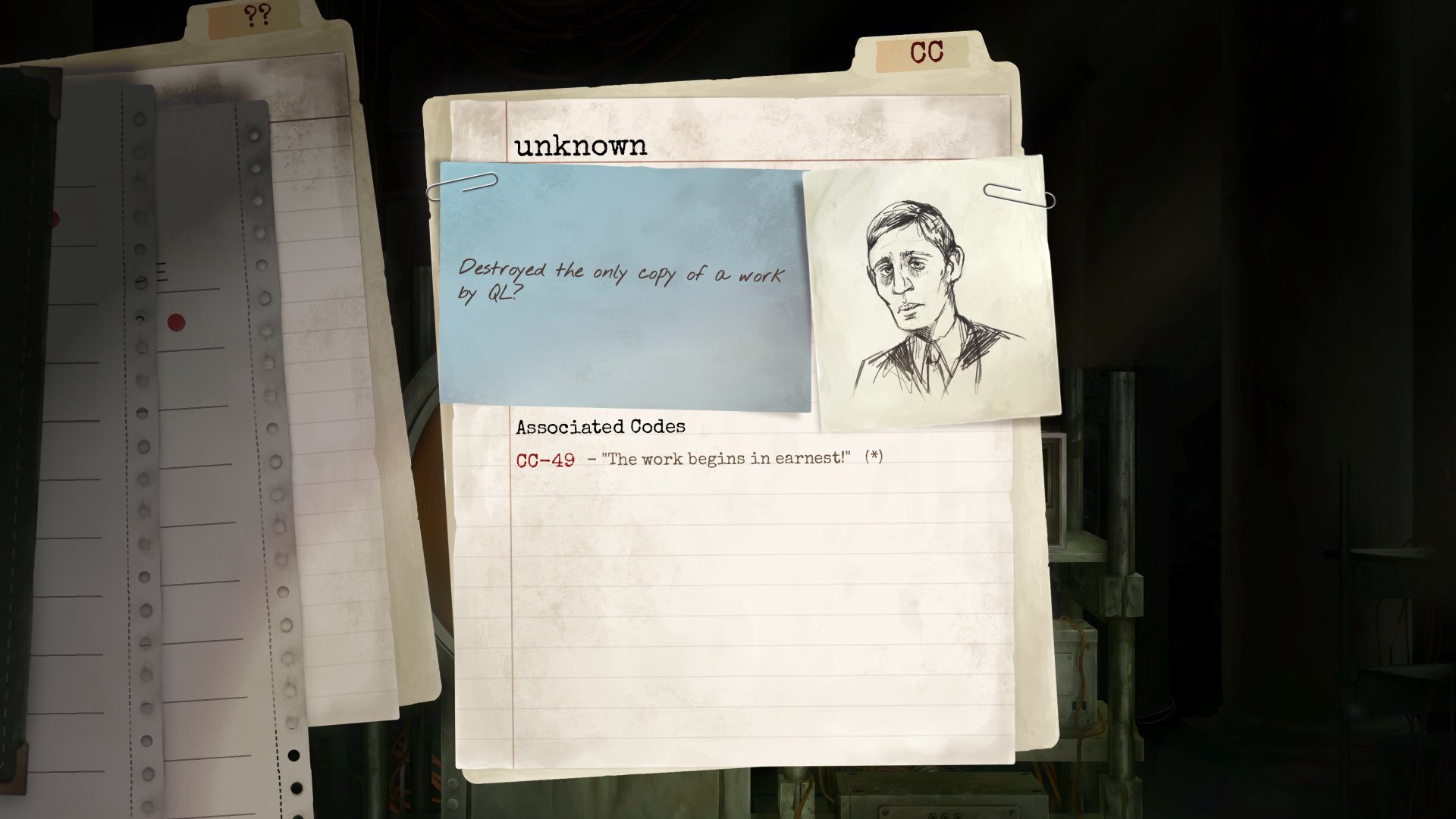
Tracking all this information could quickly become daunting if not for Abbi’s notebook, which is hands down the most useful journal I have ever seen in a game. The cover shows Abbi’s current status, which is her main thought or objective at that particular stage, and anything important that unveils itself over the course of the investigation replaces it. This works as a nifty way to corral your focus when feeling overwhelmed by the sheer number of potential codes to try and threads to pull.
Within the notebook, information is continually added about the authors Abbi encounters, what information links to them, which input codes reference the individual and more, which is an incredibly helpful tool in this sort of game. No need for old fashioned pen and paper; Abbi’s notebook has it all covered. An ‘abc’ button flashes red when new details have been added, and Abbi is impressively fastidious in her information gathering. On more than one occasion I looked at the notebook when I felt a bit stuck and Abbi had added notes for various characters that I had completely missed when working through the text myself, which then allowed me to try something new.
On a few occasions, Abbi announced that she could match a title with a code before I had made those connections myself and I found myself asking, ‘How?!’ Needless to say, a couple of brute force moments were required, which wasn’t ideal, though I didn’t mind because it meant I could cross them off the list and move on to the next. Thankfully, and the game is structured in a way that only when the answers have been revealed with the information recorded are you able to attempt a connection, so you’ll never have need to rely on trial and error when no connection is possible.
What really makes TR-49 stand out is that it bills itself as part audio drama. When the machine lands on a corrupted screen, you’ll hear a staticky, choppy voice coming out of a 1940s-style small radio cabinet. Once that source’s title has been assigned and accepted, the audio clears up and the voice speaks again, this time with clarity. These voices belong to the different authors of the books you uncover. They’ll read a passage of the related book aloud, which sounds extremely creepy while something even eerier appears on-screen. If there’s a criticism here, it’s that I found the volume of these spoken messages to be lower than the music and ambient sound, but with the text displayed too it was easy enough to follow along.
The main characters continue to communicate throughout the game via the intercom and are very well voiced, with Abbi’s actor speaking in a clear regional Northwest England accent and Liam with a calm, warm Scottish voice. A ‘buzz’ sound is heard when either of them needs to say something, which is often Abbi asking a question and Liam being frustratingly vague. Liam will sometimes chime in without waiting for a prompt (usually if Abbi hasn’t answered his ‘buzz’) but for the most part it is a back-and-forth conversation (assuming you choose to respond). A few times the intercom buzzed just as I was entering a new code to try, which meant Abbi could not respond so I felt like I lost that specific dialogue exchange. Ordinarily this wouldn’t matter so much in the overall scheme of things, but the story here is very light on clear details so I was desperately trying to piece together as much as I could.
One thing I found quite humorous was Abbi’s verbal confirmation of whether a source title dragged into an open slot in her notebook was right or wrong. After a while spent playing around with the myriad codes and titles I had accumulated, I tried a couple to see if I could get those squared away. When the title is wrong, Abbi reads it as a question – ‘Breakcode?’ – but when it is right, Abbi is thrilled and belts out the title as a statement – ‘Breakcode!’ I was buoyed to see that exclamation mark and hear her enthusiasm each time.
Voice-overs aren’t the only way that TR-49 excels in its audio. As soon as I heard the gentle piano and haunting strings in the background, I knew it was long-time inkle musical collaborator Laurence Chapman at the helm, with his work on Heaven’s Vault being amongst my favourite game soundtracks. The score is quiet, understated but beautiful, with an ambient ‘industrial’ hum of the mysterious machine completing the musical landscape.
Visually the game is fairly basic, with the code machine taking up most of the screen. There is no option to get up and move around, so the view is first person, seen through Abbi’s eyes. The circular screen on the machine that displays text is filled with a swirling copper-coloured display, with text in a complementary yellow that isn’t too harsh as a contrast. The machine itself looks old although built solidly (Abbi describes it as being made of ‘dinosaur plastic’), with vacuum tubes and wires connecting to the code input box. A muted, subtly lit colour palette is the name of the game here, with obligatory dust motes floating around. Abbi is in a cellar, after all. An important note to add here is that the screen flickers in certain parts. I saw no way to turn that off in the settings, and it may be uncomfortable for some players.
TR-49 has a very simple interface for PC users, with either point-and-click or keyboard commands being all that is needed. But it is clear that this game was built with the Steam Deck in mind, because for the most part it works extremely well on it. Scrolling up and down allows you to read source entries, and entering a code is very easy. Even if you mess up, you can move backwards or forwards without having to leave and re-enter. The Steam Deck joystick is sensitive here, though, so during a couple of inputs my cursor went flying past the intended target, or sometimes nudged itself onto a different letter or number than intended when entering the code, which was a little frustrating but easily adjusted.
Final Verdict
With an initial runtime of around nine hours for me, finding and locating 50 odd books in an even odder machine takes more time than you think, but finally matching codes with titles is an extremely rewarding feeling. The content of the books, articles and letters you uncover is more cerebral than in similar titles, and TR-49 is an original move away from the popular ‘whodunnit’ theme into something more like ‘whatisit.’ Some players will love the mysterious nature of the game and enjoy forming their own conclusions, but some might feel disappointed by the lack of clarity and fairly thin, vague explanations after all their hard work. One thing that won’t be disputed is the value of the audio drama element, which makes TR-49 unique and adds an eerie edge to this confoundingly intriguing tale, and the various secrets revealed along the way will be sure to keep players searching for just one more title.
Hot take
Its unrelenting vagueness surely won’t be for everyone, but with TR-49 inkle expands on the growing investigative deduction subgenre with another polished and rewarding title, its added audio component providing a particularly compelling extra layer of intrigue.
Pros
- Very slick, fresh take on the deductive mystery subgenre
- Extremely helpful, meticulously updated notebook
- Beautiful musical score and great voice-overs
- Unsettling moments scattered throughout to keep players on their toes
Cons
- Voice volume can be lower than the background audio
- Story could be at least a little tighter and clearer
Victoria played TR-49 on the Steam Deck using a review code provided by the game's publisher.

- Advertisement
- Help support AGH by advertising with us







1 Comment
Want to join the discussion? Leave a comment as guest, sign in or register in our forums.
I enjoyed TR-49 very much. Immersive game, would rate it 85 or even 90%. I agree with your review for the most part but I don't understand your problem with the voice volume. You can change 4 different audio settings: master, sfx, voice, and music. After a couple of hours I turned the lovely but repetitive music off.
Reply
Leave a comment