
Detective Hayseed: The Cloning Madness review

- 3 Comments

Remastered localization of popular Czech adventure unable to duplicate the success of the classics that inspired it
A detective that nobody seems to like. A city filled with clones of famous people. A mysterious fire, a bomb threat, and weird letters to gorgeous women to investigate. Beautiful cartoon graphics and a solid musical score. These sound like the pieces of what should be a great adventure, but unfortunately Detective Hayseed: The Cloning Madness doesn’t live up to those expectations due to its poorly written characters and illogical and confusing puzzles that remain even decades after it first appeared.
Although it’s not indicated in the title, this is actually a remaster of the second game in a long-running series by Czech developer SleepTeam and Zima Software. The first, called Polda in Czech, was released in 1998, which starred a cop called Pankrac as he investigated a series of strange kidnappings. It was a cop-comedy adventure drawn in a cartoon style, and was the best-selling game in the Czech Republic the following year.
Due to its immense popularity, Polda 2 was quickly released in 1999, and again it was a national best seller. In fact, the games were such a hit locally that they spawned five more sequels, with another currently in production. As well-received as they were in their native country, however, these games weren’t widely known in the English-speaking world. It wasn’t until 2010 that the first three games were released to a broader international market (translated into English and French) as mobile exclusives.
The first game to be localized for PC release was the sixth game in the Polda series, updated and re-released in 2016 as Detective Hayseed: Hollywood. Fast forward to 2023 and it was Polda 2’s turn, similarly remastered in hi-res with English, Czech, and French language options, and it too was rebranded, this time to Detective Hayseed: The Cloning Madness.
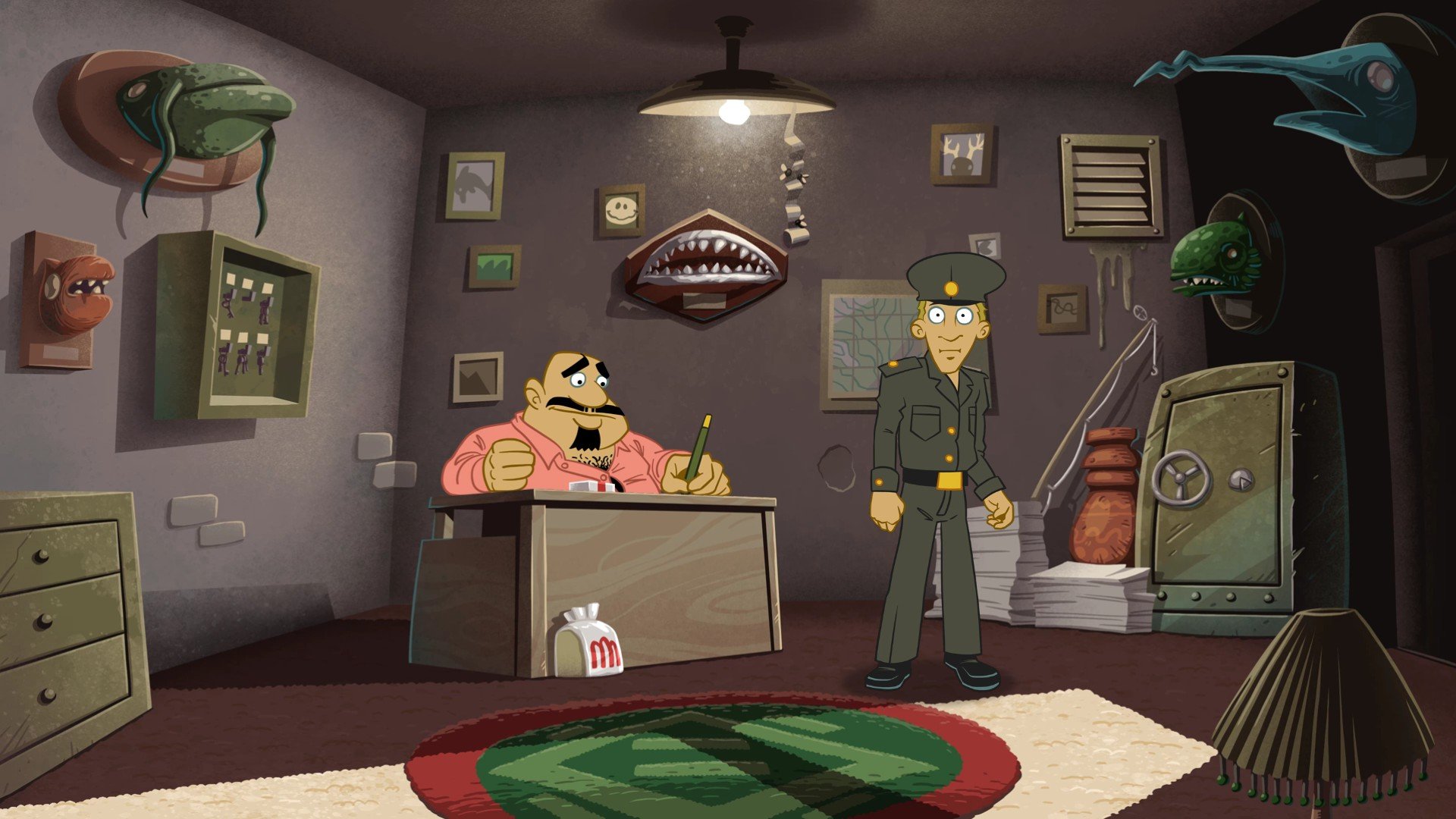
As I understand it (not having personally played the original), the story and gameplay haven’t changed in this remaster, which finds the renamed Detective Francis in a well-realised and slightly whacky world in which human clones are accepted as normal. Francis is quite disliked by all the other police officers at the Monroe station. Although the reason is never stated, it might have something to do with his wisecracks to most situations, which become quickly irritating.
Although he’s not respected by his boss either, Francis is the only cop available to investigate an important case involving the kidnapping of a clone of Claudia Schiffer, the favoured contestant to win the clone modelling awards. As a last resort, Francis is tasked with finding her, but before he even gets to start his investigation, he is abruptly removed from the case. It turns out his boss REALLY doesn’t think he’s competent.
Yet after successfully (and surprisingly) capturing a criminal, Francis’s boss throws him a different assignment that sends him to investigate a mysterious hotel fire, strongly suspected to be arson. After completing that he is given another mission, this time to uncover a serious bomb threat at the old castle, Cloneburg. Then a third case, where a group of women (clones again) who all live at or near Paradiso Beach are being harassed with anonymous letters, is given to Francis to once again solve the mystery.
What connects these three seemingly separate cases is a mysterious object you pick up during the first one, which you slowly discover is an important clue to the location of the kidnapped Claudia. The overall narrative makes sense and unfolds in a way where you always know what you’re trying to achieve. While each case is self-contained for the most part, that thread of the missing model keeps popping up, and it’s not done in a forced or random way but rather is integrated with the rest of the plot.
The main aspect that’s been changed in this updated remake is the graphics. Even if you haven’t played the original game, there is an option to switch between those graphics and the remastered version. It’s a smooth transition but there is clearly a massive improvement in every piece of artwork. Plain grey pathways at a castle suddenly seem more realistic with shadow and markings, and the tower and trees in the background go from a blurry mess to defined and atmospheric elements that make the world seem more real, albeit in a still obviously whimsical way.

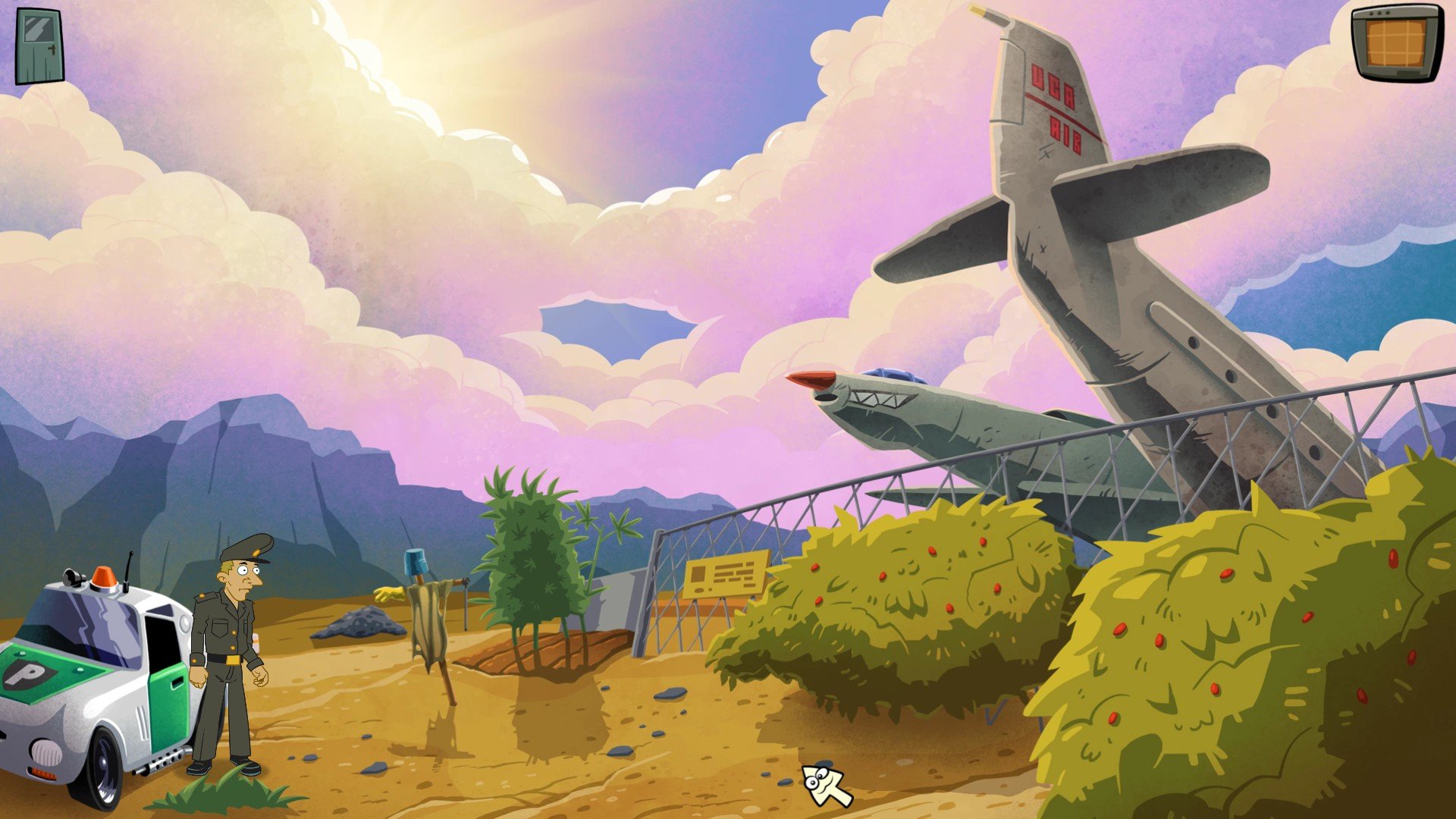
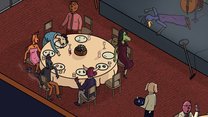
As you explore Monroe and the surrounding region, this enhancement further emphasises what was already The Cloning Madness’s biggest strength: the artwork. It is simply great. Drawn in a cartoon style with vivid colours, it brings to mind the classic Warner Bros. cartoons like Road Runner, utilising an elastic (or rubber hose) art technique, where the proportions are slightly bent or distorted, and everything that should be straight seems slanted in an exaggerated way. The silly fun is best found in the smaller details, like a stuffed dinosaur head on a wall, or a topiary shaped like Snoopy. It’s things like these that really help make the world feel distinct and unusual.
The animations, such as the ill-proportioned police car Francis drives between locations, or the overly-muscled bouncer outside the Rockbar Club (a nightclub you visit in the North Docks during your investigations), also showcase the slightly twisted sensibility, giving The Cloning Madness a comical feel without going overboard. There are a few times, however, where a lack of animation detracts from the overall experience, such as when Francis starts a fire and the aftermath is depicted only by a black screen with descriptive text explaining what happened.
Detective Hayseed: The Cloning Madness

| Genre: | Comedy, Mystery |
|---|---|
| Presentation: | 2D or 2.5D |
| Theme: | Conspiracy, Crime solving |
| Perspective: | Third-Person |
| Gameplay: | Puzzle, Quest |
| Control: | Point-and-click |
| Game Length: | Medium (5-10 hours) |
| Difficulty: | Medium |
| Graphic Style: | Cartoon |
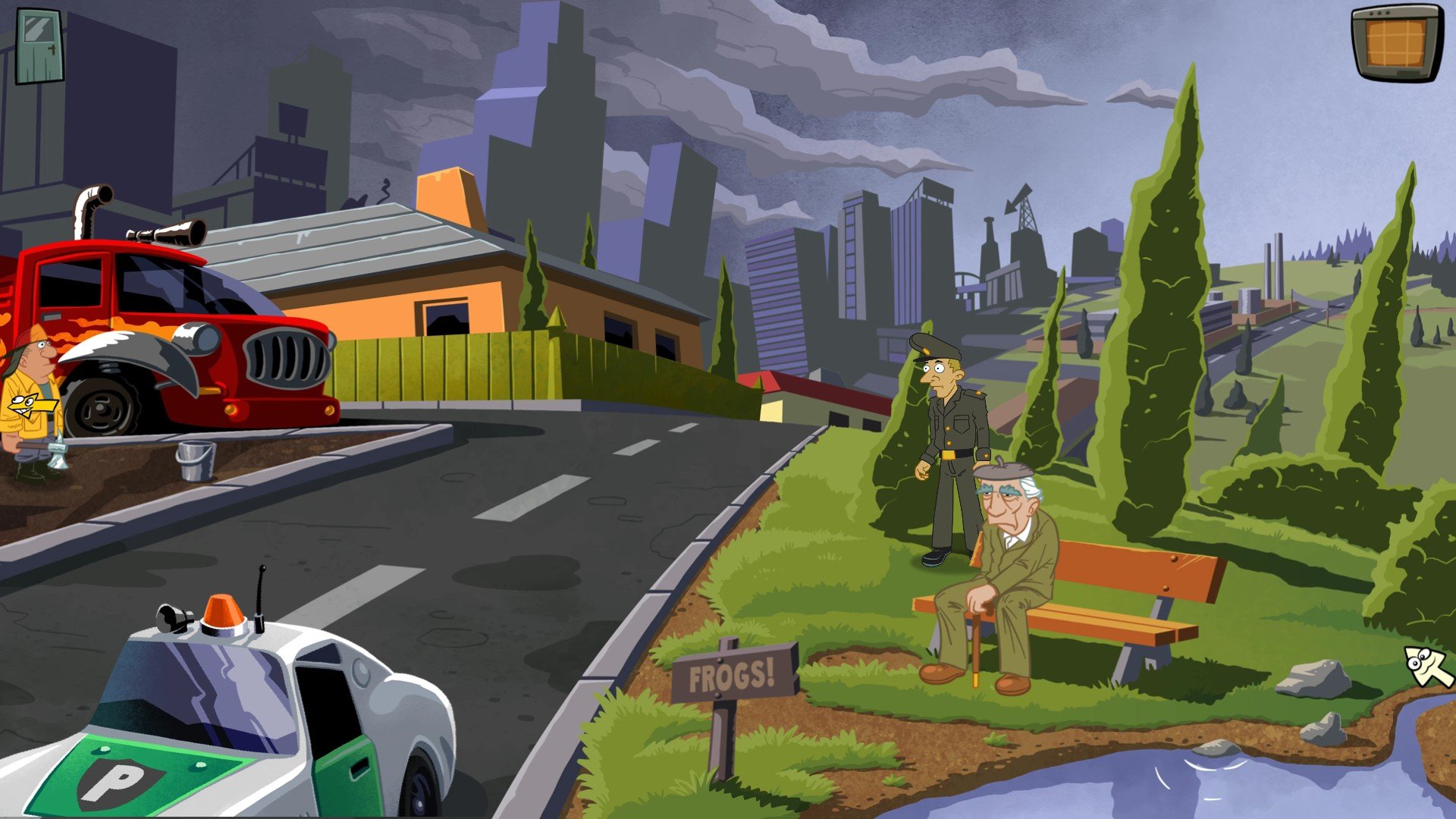
In the course of investigating crimes, Francis will drive his police car to your desired destination, selected via an overhead map. Each location is unique and extremely well realised. The hotel set on fire is bordered by a park on one side, the city skyline behind it fading into dark purples and blues that effectively convey a sense of distance. This juxtaposes well with the red fire engine and bright yellow uniforms of the firefighters in the foreground. Other notable locations are the Sidestreet Boys’ circus, a large pink and green tent surrounded by brightly coloured wagons and a truck; and the castle under threat, filled with rooms of such colourful characters as Hitler and Napoleon clones, its exterior surrounded by a moat.
My personal favourite, though, is the DNA laboratory, a parody of the classic 90s comedy Bio-Dome, all yellow desert sands and giant cactus plants. What appeals to me about this particular scene is the sun setting in the background, casting long shadows. Some of the major scenes like the junkyard have effective musical accompaniment in a soft-rock style of synthesised drums, guitar and keyboards, while others like the Hybridarium, an eerie cloning facility, is served by the sound of chirping birds, enhancing each location.
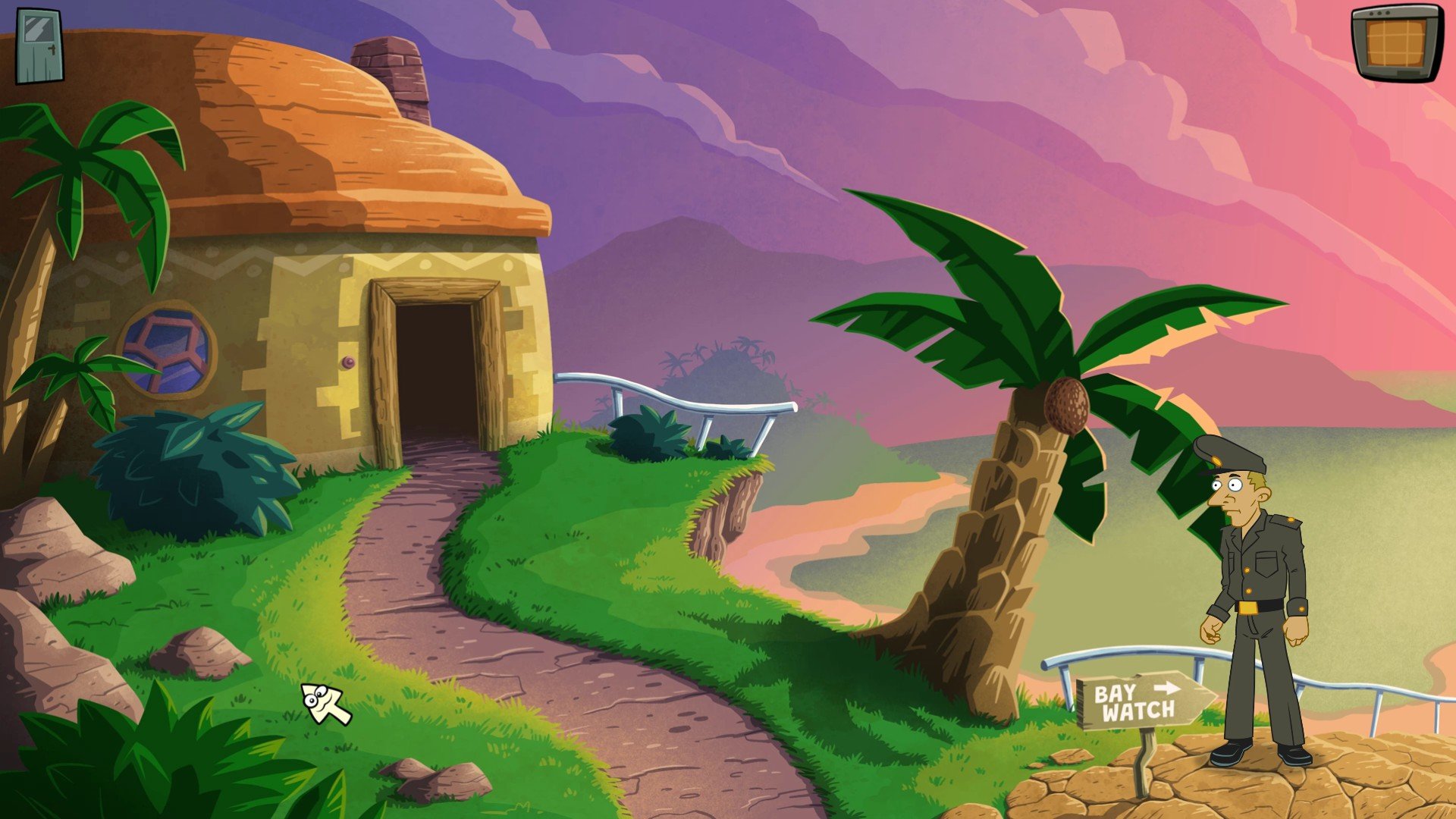
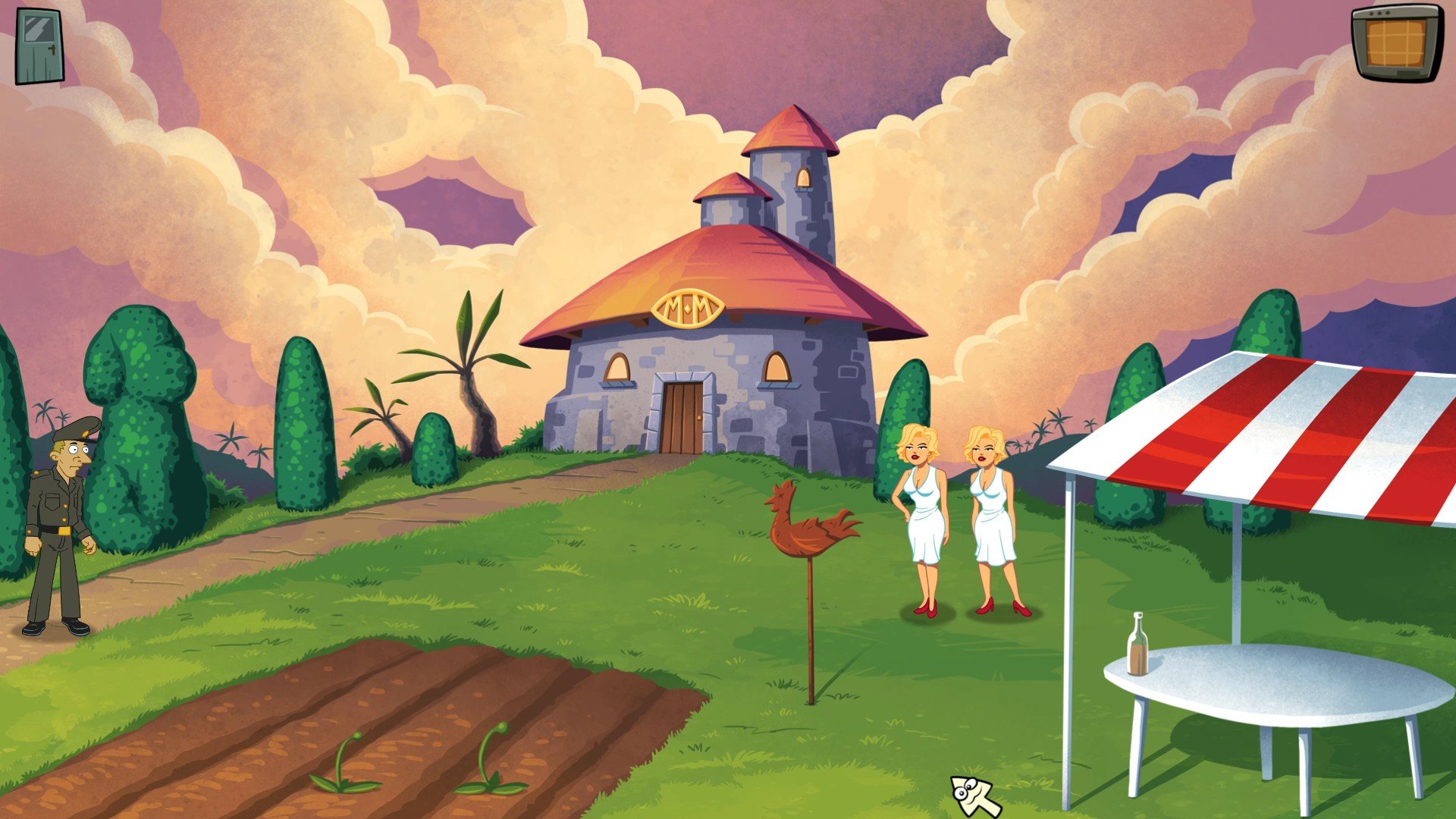
The city of Monroe is a small but very strange place that prides itself on its huge advances in cloning, so not surprisingly it is filled with a colourful array of characters, most of whom are replicas of famous people. You’ll meet people as diverse as Al Capone and Michael Jackson, Pamela Anderson and Albert Einstein, and a set of twin Marilyn Monroes. Most games would at least try to hide the parody a little, but The Cloning Madness embraces it. These people are referred to by name, and aspects of their real lives are mentioned throughout the plot, like Michael Jackson’s legal troubles, or Pamela Anderson lying on a beach called ‘Bay Watch.’
It all makes for an interesting setup, so it’s a shame that the side characters have little to no depth or narrative relevance beyond most of them being a clone of someone famous. And while every character is voiced, the quality is uneven. They’re all solidly recorded and professional-sounding but quite a few, like Pamela, talk slowly. A lot of the male voices also have a forced Brooklyn accent, especially Francis, which is good if somewhat stereotypical. One I do particularly like – because it reminds of the Beagle Boys in DuckTales – is Simon, another slow-talking character, a dumb-but-with-a-heart-of-gold fellow cop who helps you out in your investigations.
The controls are very simple: a left-click will either cause Francis to walk to that location or interact with an object or person. The inventory is accessed through an icon in the top-right corner of the screen (a door icon in the top-left opens the main menu, where you can manually save and restore). Simply click on an item there to select it and again on the person or thing you want to use it with. Some objects can be combined first, adding another level to the challenge.
Most of the gameplay is a traditional blend of questioning characters and inventory-based puzzles. As you’re a detective, you need to investigate crimes by talking to people, so pay close attention to every dialog. Generally, conversation topics will change depending on what you have previously done or said. Sometimes you will need to present an object to someone to get them to reveal important information, like pulling your handgun on them or waving your police badge in front of them to prove who you are. (Although Francis rightly mentions on a couple of occasions that his police uniform should be enough.) Different responses are available for the most important conversations and interrogations, but these don’t appear to me to make much difference in the story.
The inventory-based puzzles are a mixed bag, sometimes making logical sense and other times making no sense at all. Having to mix plaster to take a mould of a footprint for analysis is intuitive. [Small spoiler warning] Putting a golf club in a flare gun as ammunition definitely isn’t. [End spoiler] Some items are used more than once, especially your standard police equipment like your gun and badge. There’s certainly a bit of 1980s adventure game design evident in items sometimes being scattered around the city for no apparent reason except that you will eventually need them. And there was one case where I had to pixel hunt to locate a wire, which was quite frustrating.
One noteworthy puzzle is the defusing of a bomb, which has a timer attached. Normally I’m not a fan of timed puzzles, yet the logic of a countdown lends itself well in this case. If you let it run out, the bomb will kill you, although thankfully the game will simply restart the sequence to try again. This was the only death I experienced during my eight hours of playing. What makes this particular puzzle enjoyable are the multiple different aspects to it, from unscrewing panels to pressing switches and cutting wires in a first-person close-up view. Every part of this process is intuitive – at least, after you’ve acquired all the inventory items needed to complete it, in places that have no connection to this event.
That sort of thing happens a lot. The old trope of picking up everything that isn’t nailed down is extremely relevant in The Cloning Madness. [Small spoiler warning] An old rag with no reason for being there is found in one location and used with gasoline from another unrelated location to eventually light a fire at a third, again unrelated location. [End spoiler] Even when the actual item usage makes sense, like in this situation, the fact that you don’t have an in-game reason to take the items in the first place other than because you can really lets down the whole story. While most adventure games do this to a certain extent, the problem is that a lot of the puzzles here do it, and after a very short time it just becomes a case of clicking on everything rather than reasoning anything out.
There is a comprehensive hint system for the first portion of the game, and a full walkthrough can be easily accessed if you need help after that – although it should be noted that the walkthrough misses some steps occasionally and names things in what I assume was the Czech original, rather than the remastered English version. However, the only time I used the walkthrough on my first playthrough was where a bit of pixel hunting was required to find things I didn’t even know I needed.
Unfortunately, some of the inventory-based puzzles go further than being just nonsensical. [Small spoiler warning] In one scene, Francis stops a woman from screaming by placing a literal cork in her mouth, while in another you interrogate / torture a suspect who is chained to a wall by blasting his arse with high-powered water from a hose. I found it particularly repulsive to offer alcohol to an alcoholic in order to get him to help you. [End spoiler] I appreciate that different people have different senses of humour, and I also realise this is a game whose writing is a quarter of a century old, but some of these scenes really didn’t land for me.
Then there are the disparate tones running throughout. At some points, Francis is shown to be a bit of a bumbler who isn’t even given ammunition for his gun early on. Other times he is seen as very strong and direct in the way he interrogates criminals and solves crimes. On one occasion he gives a baby a rattle, showing a caring side, but elsewhere he launches into a profanity-filled tirade at a suspect. It was the tirade that really surprised me, both for the amount of angry (fully voiced and uncensored) swearing involved, and the fact that it came out of nowhere. Yes, the suspect wasn’t cooperating, but it wasn’t the first or last time that happened. Even for a comedy adventure, the unevenness of Francis’s characterisation really does detract from proper immersion.
In each of the three cases you solve, you find a clue for what happened to Claudia, the model that you were ever-so-briefly assigned to find back at the start of the game. Eventually you put those clues together to discover her whereabouts, and without spoiling the ending, the story finishes with Francis taking off in a hot air balloon for places unknown. It’s at this point that the original game finished, but due to enthusiastic fan support, a playable add-on was created that sheds light on the gap between this and the next game in the series. While this extra section is included in the remaster, unfortunately it remains only in Czech, so I wasn’t able to play it to its conclusion.
Final Verdict
It’s possible that the poor characterisation and questionable dialog are products of humour or nuance being lost in translation, although the dialog makes sense so I can only assume the translation is well-done. But the puzzle design flaws are more likely a result of an outdated 90s adventure game being given a graphical makeover with the rest of the gameplay left intact. There are some clever puzzles but they’re the exception rather than the rule, and for every bomb to defuse, there are half a dozen examples of mindlessly picking up random objects and hoping they come in handy later, sometimes in ways that strain credulity even then. While the great strength of Detective Hayseed: The Cloning Madness is its amazing cartoon world, it's just not enough to offset the parts that frustrate rather than entertain.
Hot take
The hand-drawn world is beautifully remastered and the story hints of promise, but Detective Hayseed: The Cloning Madness is riddled with illogically designed puzzles, poorly written characters and misplaced attempts at comedy.
Pros
- Beautiful cartoon-style backgrounds
- Solid story broken up nicely into three distinct but connected acts
Cons
- Some terribly illogical puzzle solutions and random item placement
- No depth to any of the supporting characters
- Very uneven characterisation of the protagonist
Shawn played Detective Hayseed: The Cloning Madness on PC using a review code provided by the game's publisher.

- Advertisement
- Help support AGH by advertising with us




3 Comments
Want to join the discussion? Leave a comment as guest, sign in or register in our forums.
There is a mistake in the introductory text of the review: it’s a Czech game, not a Polish one.
Reply
Whoops, yes indeed. Will correct, thanks!
Reply
I am fascinated by the Polda games. They are part of the surpringly big section of point n click adventures developed in some European countries for local consumption (Poland, Germany, Italy or Spain have a few of these) and what is surprising is that, once you get the translation, these local games end up being so similar, reliant on local references but having a grotesque sense of humour that reflect very well the culture they were developed in. Polda 7 in particular started with a puzzle about getting a beer without getting out of the couch that absolutely enamored me. Bottom line: I will get it.
Reply
Leave a comment