
WARPed minds: Revisiting the horrors of D, D-2 and Enemy Zero

- 1 Comment

While most horror gamers are surely familiar with companies like Team Silent (Silent Hill) and Capcom (Resident Evil), WARP, a Japanese company that existed from 1994 through 2000, produced several highly experimental horror games of their own on the Sony PlayStation, PC, SEGA Saturn and Dreamcast. Though they have their niche fan bases, WARP’s titles are not often mentioned in adventure game discussions, perhaps because they simply aren’t as well known in the West as they are in Japan. Or, perhaps it is because they do not neatly fit into any single gameplay genre.
WARP’s first foray into the genre, D, was a technically impressive and uniquely designed cinematic production. While it is undoubtedly an adventure game, their subsequent titles Enemy Zero and D-2 later added more action and can be classified as survival horror, though they retain some of the same adventure-style elements as their predecessor. I recently revisited these three experimental titles, both to see whether they have stood the test of time, and to try to determine whether I could find a proper categorization for them outside of their obscure corner of horror gaming history.
D
Released in 1995 (but set in 1997), D opens with a cauldron of bats flying over a pink haze while police spotlights attempt to pierce the mist. This results in blood-red beams painting the exterior of a Los Angeles hospital where, as the narrative text states, a murder has taken place. (Well, murders, plural, to be accurate.) The killer is identified as Doctor Richter Harris. Up to this point, only the gentle tune of a piano and the faint wail of police sirens have been heard, but when Richter appears on-screen, he aims his gun at the camera, shuddering your speakers with loud bangs as he fires off several shots.
Next we see his daughter, Laura Harris, speeding down the freeway at night in her yellow convertible, hoping to reach the hospital and talk some sense into her father. The roads are empty, creating a sense of unease (not to mention a totally inaccurate depiction of Los Angeles). This unsettling feeling continues upon taking control of Laura as she walks cautiously towards the hospital entrance, alone, her footsteps the sole sound as she enters the scene of the massacre.
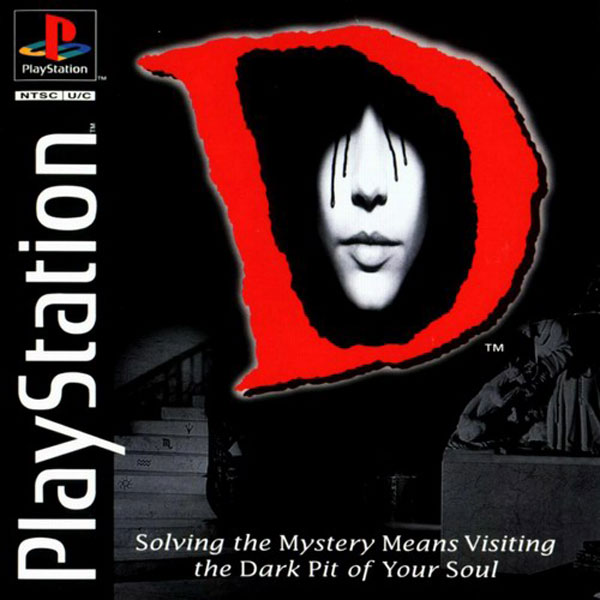
Once inside, Laura witnesses the murder scene for herself, with blood covering the floor and bodies strewn throughout the lobby. Before she can fully digest the horror, a curious formation begins to shimmer in front of her. Walking towards the disturbance, Laura is consumed by the mysterious force. When she opens her eyes again, her surroundings have changed. She is now inside a dimly lit manor with stonework walls. A dining room table sits in front of her, with several doors to different wings of the home beyond that. As if things couldn’t get any stranger, another disturbance emerges before her, manifesting into an apparition of her father’s head, warning Laura to leave before the portal to her world closes off for good.
Though it is not noted in the game, the instruction manual states that players have only two hours (real time) to complete D before the “bad ending” will occur, trapping Laura in her father’s dimension forever. There is no saving, no pausing, making this game something of an oddity in the adventure genre, in that you have to commit to playing it in a single sitting.
While it wasn’t uncommon for games of that era to feature pre-rendered cutscenes, especially for introductions, D maintains this pre-rendered style throughout. It’s essentially a series of short cinematics sewn together into a node-based experience via full-motion video, as opposed to a series of still images like Myst. Lara’s slow and laboured pace, with the screen bobbing up and down with every step, increases the tension, spurring you to look around the screen for potential surprises lying in wait as these short cinematics play out. It also inspires an appreciation of the incredible amount of detail crafted into each and every area.
The game’s graphics were built using Amiga 4000s, which were powerhouses of 3D graphics in the early 1990s. The perspective stays in first person while you control Laura, allowing the scenery to stay static as the game awaits your input. However, D frequently (and seamlessly) switches to non-interactive cinematics showing Laura engaging with a point of interest or being ambushed by some macabre trap.

Though the game’s smooth use of pre-rendered visuals is notable, the sound design is just as worthy of praise. Kenji Eno (the game’s director) composed the score himself with haunting piano and orchestrated tunes. Though most of the gameplay segments when walking around between nodes are quiet, music is featured prominently when interacting with the environment. During the quiet moments, little details like Laura’s footsteps making different sounds depending on the surface add to the immersion, while a sadistic use of volume manipulation punctuates many of the game’s jump scares.
Pushing forward on a controller’s d-pad (or arrow keys when playing on PC) at any given node causes Laura to walk forward, while left and right will prompt her to turn towards the next available path. With everything being pre-rendered, you cannot look about the environment freely. However, with so many points of interaction and a unique walking animation between each node, the game feels more immersive (albeit slower) than statically rendered games of the era. Laura’s unhurried pace not only allows you to digest the nuances of every location, it acts as a constant reminder of the time limit. With no pausing or saving your game in D, each step taken must be calculated.
Pressing the action button will interact with points in the environment (if available), like puzzle mechanisms or items. Whether or not Laura can interact with something she is looking at is simply a matter of trial and error. Some stops have no opportunity to do so, they simply act as pathways to other nodes. While the lack of a hotspot indicator may seem cruel, a point of interaction (like a lever or drawer) is typically framed in the centre of the screen, while a non-interactive one (like a bookcase) is viewed up close with no point of focus.
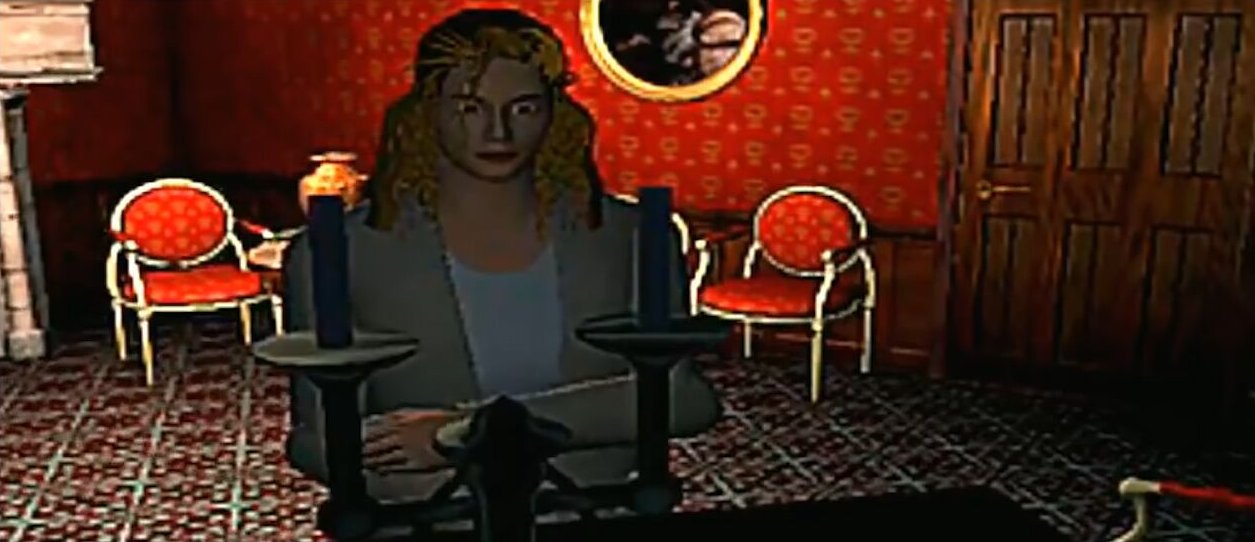
D has no on-screen display, but an inventory can be opened to browse and use the items you have picked up via a gallery of pictures depicting them. Laura is essentially mute, meaning all of the clues are conveyed through animation and body language reactions, like Laura shrugging her shoulders if she reaches a locked door if you have not yet found the key. There is no notebook, so you will have to keep track of the various doors and puzzle parts yourself. However, using the compact in Laura’s inventory will give you a visual clue of where to go next.
Though there are some action elements, including a quick time event sequence, only the timer running out will result in a Game Over. Puzzles can be challenging and mostly consist of combination locks, like a numerical puzzle requiring you to open dresser drawers in a specified order, or a telescope aimed at different zodiac signs.
Should you find Laura’s father in under two hours, you will have to decide his fate, with either choice prompting a unique ending. Completing D within the allotted time limit is not an impossible feat by any means, though it may take a few tries to fully explore the environments in order to plan the optimal route through. Certain rooms or points of interaction are only there as a distraction or to provide a jump scare. While some of these can be skipped during replays, there is another random element in the form of mysterious glowing beetles hidden at predetermined points. If you uncover all of them, these beetles provide Laura with flashback cinematics showcasing the Harris family’s horrifying history – though this is totally optional.
Interestingly, these optional scenes caused quite a bit of controversy in the game’s rating process. Without giving away too much detail, the flashbacks depicted in these scenes imply that Laura and her family have been supernaturally cursed, which has on occasion prompted some to indulge in cannibalism. Purportedly, in order to get his game out uncensored, Kenji Eno submitted a version of the game without the controversial cannibalistic scenes to the ratings board but secretly delivered a final build of the game to the distributor with the scenes intact, with the ratings board none the wiser.
Overall, D is a well-produced puzzle adventure, just a different sort from most in that period. The strict time constraint and lack of saves all but demand multiple playthroughs, but the effort is rewarded with hidden collectables and multiple endings. The visual presentation, while certainly dated now, both dazzled and terrified players in its day with its mix of detailed pre-rendered first-person exploration and cinematics. The predetermined exploration routes and interaction points prevent the game from ever becoming a pixel hunt, though admittedly it can become tedious as you wait for Laura to finish her painfully slow walking animations. D is the purest adventure that WARP would make. However, even as they broadened their approach to the genre, the mechanics and style of this game remained a backbone to the studio’s subsequent titles.
Enemy Zero
Released in 1996, Enemy Zero is a sci-fi game set aboard a deep space scientific research vessel. This game sees Laura return as the protagonist, but in a rather oblique fashion. She is now named Laura Lewis, and from this point forward, WARP would refer to Laura as a digital actress, essentially casting the same woman we know from D in an entirely new, unrelated role each game.
Here Laura is an officer aboard the AKI, along with her colleagues Kimberley, Mercus, Parker, David, Ronny, and George. Split into four towers (Autumn, Summer, Spring, and Winter), the AKI is massive and its inhabitants are separated amongst these quarters. It’s so big that the crew often utilize the ship’s VEXX Network – a video call and map system – to keep in touch, as traversing the vast distances between the towers takes considerable time.
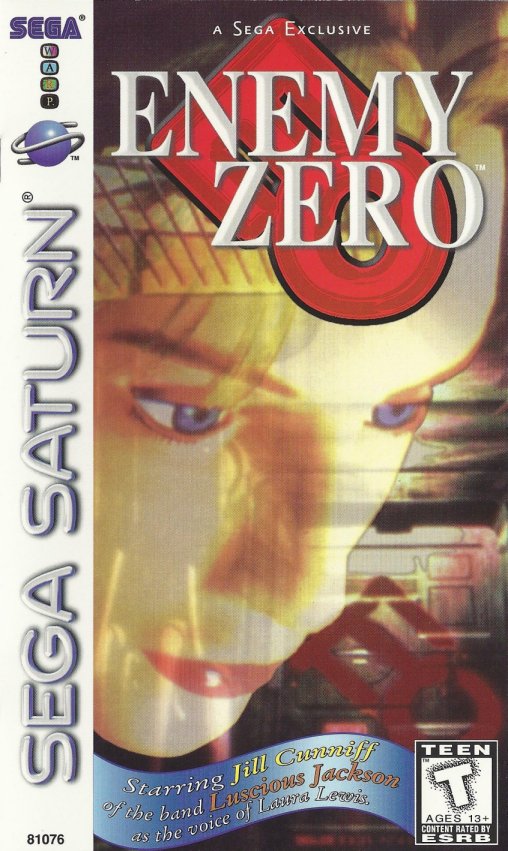
The game opens when Laura is abruptly awakened from cryosleep. She immediately tries to contact her crew via the VEXX Network to ascertain what is going on. While doing so, she sees one of her colleagues murdered live on video by an unknown, seemingly invisible culprit, and decides to go and investigate.
Though it echoes some of the adventure formula of D with its focus on puzzles and navigating pre-rendered environments, Enemy Zero is decidedly more of a survival horror experience, with resource management being a key element. The gameplay here is split into two distinct sections: shooting and exploration. The shooting segments take up the majority of the game and are interesting, albeit… strange. Standing between Laura and her crew are packs of hostile aliens waiting to tear her limb from limb. Armed with only a pistol, she must avoid or dispose of these creatures, as one hit from them will send you to the Game Over screen.
Oh, and did I mention that all of the aliens are invisible?
Enemy Zero’s twist is that Laura must use a special earpiece that detects movement around her. A high pitch coming from the piece means it senses motion ahead of her, a low pitch behind, and medium to the left or right. The pings increase in frequency as the source moves closer to her, meaning you must trust your ears and position yourself appropriately in order to line up your shot and destroy the aliens.
Complicating things further, Laura’s guns must be regenerated at a charging station after every few shots. And one more thing: the shots must be powered up for a few seconds in order to successfully fire… Wait, still one more thing (I promise, last thing): each shot only travels about two meters, so you’ll have to lure the enemy right in front of you and time your shot perfectly to the moment right before it closes in.
Being surrounded by invisible aliens while differently pitched pings invade your speaker can be intimidating, to say the least. In these corridor segments, the graphics switch to a first-person shooter engine with full freedom of 3D movement but no on-screen display, even a targeting reticle. Why the guns work the way they do, or what use Laura’s earpiece would be outside the context of fighting invisible aliens is never explained. Suffice to say, this game is very hard, very bizarre, and very, very scary.
The other part of Enemy Zero is exploration of “safe rooms,” where the game incorporates FMV, exactly like D. Here Laura is fixed to predetermined paths, but the flow between routes is much smoother and the animations much faster than in the previous game. The graphics were rendered in PowerAnimator (the same tools used to create the visuals for movies including Terminator 2: Judgment Day).
Though it maintains the same style and cinematography as its predecessor, with Laura’s head bob connoting each measured step, the aesthetic offers more convincing lighting details this time, as well as less visible polygonal seams in the character models. The sleek, clean, and colourful futuristic art style is unified in everything from Laura’s clothes and gear to the ship’s architecture. It’s a beautiful game to behold, wholly leaning into this (now retro) pre-rendered style.
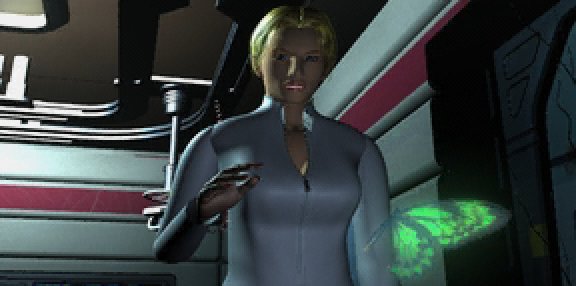
The node-based controls, or rather pre-set pathways, of these segments have been improved too. Seldom will you have to back away from a point of interest, turn, and then move back in just to examine a nearby object. That makes exploration much less cumbersome in Enemy Zero than in D, though no less suspenseful thanks in large part to the danger awaiting Laura outside each safe room. Puzzles often take place across several rooms, meaning you will need to combat (or evade) the stalking aliens as you move about gathering clues and items around the AKI.
Puzzles are of the standard survival horror variety, including obtaining keys, numerical codes, or ID cards (or other biological bits for confirming identity…) for locks or to access certain subsystems, as well as tweaking power and pressure levels via computer systems. What’s so immersive about the adventure sections (besides the temporary reprieve from the alien onslaught) is the VEXX Network, which is available in most rooms. This allows Laura to check in with her colleagues, adding a level of connection to the crisis.
These exchanges may be related to tasks that need to be completed, or provide clues via looking around someone’s room with their web camera. However, some of these communications are just used to chat. Laura spends relatively little time in the actual company of her crew, but the video connections build backstory and relationships. You don’t have to try to call every crew member every chance you get, though some optional cinematics will trigger if you are persistent. The other crew members are fully voiced in these cutscenes (though Laura is not), and though the lip-syncing isn’t perfect, the actors do a good job of bringing their characters to life.
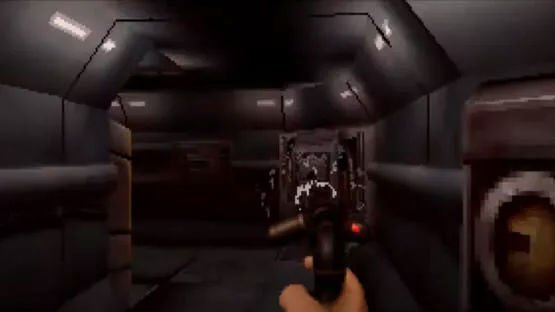
While many of Enemy Zero’s interactions take place in first person, the game does frequently switch to a more cinematic camera view when Laura engages with different points of interest. It’s a perfect balance of immersion and character building, allowing you to slip into Laura’s shoes and experience the world first-hand, but also to see how she reacts to her interactions with other characters, or even just superfluous things of interest in the environment, like the picture that David (her boyfriend) keeps of her in his quarters.
Though she doesn’t speak during the game proper or in VEXX Network videos, Laura isn’t entirely silent anymore, as she was in D. When using her handheld voice recorder (the game’s save system), Laura is voiced by Jill Cunniff, of the band Luscious Jackson. Cunniff does an amazing job of recounting the unique situations Laura is in each time you load your game.
There is no time limit here like there is in D, but the save system has its own survival horror twist, depending on your difficult setting, chosen at the beginning of the game. On Normal, recording your progress takes three units of battery while loading a game takes one. These battery units are finite and cannot be recharged. Thus it’s conceivable that you could run out, meaning you would need to start the entire campaign again if you save or load too many times. This also means you won’t be able to hear all of Laura’s unique recaps the first time through, encouraging replays. A single playthrough will take 5-10 hours, depending on difficulty and familiarity with the ship’s labyrinthine layout.
Developer Kenji Eno gave up the conductor’s podium this time around, with Michael Nyman composing the game’s soundtrack. Nyman’s piano score gives the game a fitting, and depressingly eerie, atmosphere. The score really only comes into play during cinematics, with the actual gameplay sections (both in safe rooms and shooting segments) comprised only of sound effects.
Enemy Zero isn’t truly an adventure game due to its heavy emphasis on combat. However, the adventure sequences remain a major part of the experience and they were upgraded and smoothed out from D. Though it may not appeal to adventure game purists, the variety of challenges (and optional interactions) make for a game that’s delightful to explore in between confronting hidden enemies. With its characters, safe spaces and intriguing audio-based hook, Enemy Zero nicely bridges the gap between adventure and action genres in a unique way to separate it from its survival horror contemporaries.
D-2
Originally planned for the ill-fated 3DO M2 console before being completely rebuilt for the SEGA Dreamcast, D-2 was WARP’s last major release. Though the title suggests it is a sequel to D, it is rather, like Enemy Zero, more of a spiritual successor and not a direct continuation of D’s story.
WARP refashioned their digital actors from Enemy Zero, with Laura (Parton), Kimberly, Parker and co. stranded in the Canadian Arctic after their plane is struck by a meteorite. Laura awakens in a log cabin several days after the crash, having been cared for by Kimberly. After a brief tutorial on surviving in the frozen wilderness, and a warning that the plane’s passengers have begun transforming into rabid plant monsters, Kimberly gives Laura some basic equipment as she sets out to find survivors and contact help.
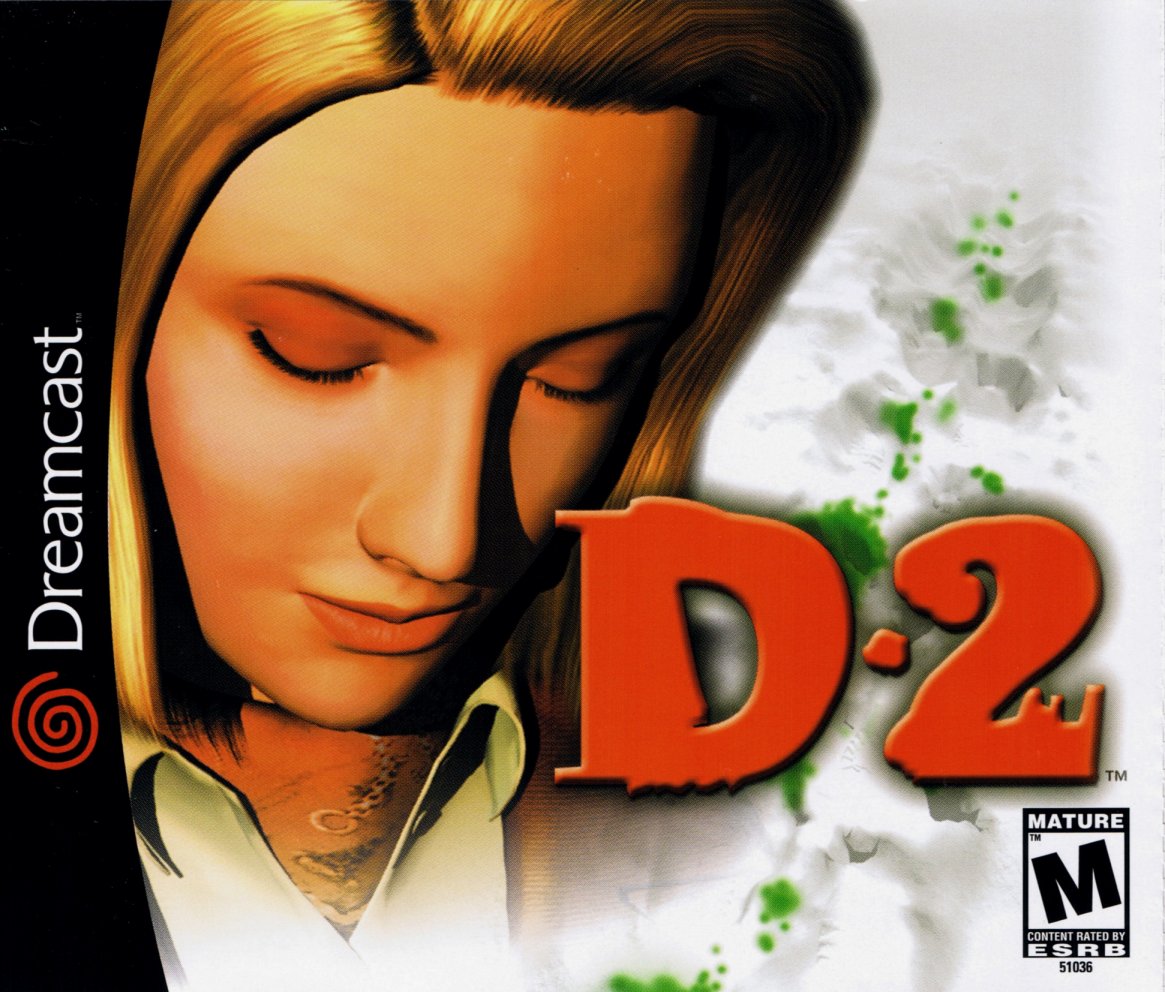
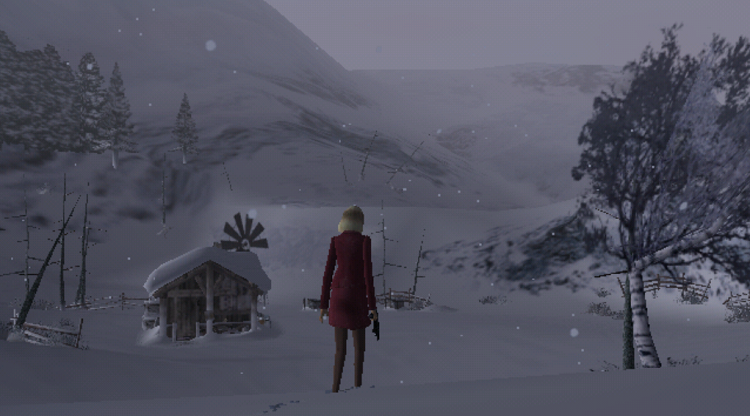
Unlike the studio’s previous games, the majority of D-2 is played from a third-person perspective, with Laura trudging through the snow (in horribly winter-inappropriate attire). However, throughout these vast open sections you are subject to random encounters with the aforementioned plant monsters via first-person shooting segments. Once begun you remain stationary, but you can swivel left or right as the monsters encircle you by pressing the required buttons when prompted to do so, somewhat akin to an on-rails light gun game. Experience points are awarded for surviving these encounters, and Laura can “level up” like in an RPG, awarding her more health.
D-2 is primarily a survival horror game, though quite unlike Enemy Zero. Resource management is less cumbersome this time around, as several of your weapons have unlimited ammunition, while ammo for the others is doled out generously. Also unlike Enemy Zero, here Laura can take multiple hits from enemies, and opportunities and items for healing are plentiful. Her health can be restored by first aid sprays, found in limited quantities throughout the environment, or by hunting wildlife. You can stop and use your rifle while in the main exploration segments, aiming (shakily) at everything from pigeons to moose, cooking the meat for consumption on her portable barbeque.
While the addition of hunting was ambitious, it is ultimately optional, as you’ll often have more than enough health recovery items at your disposal. (Laura can also rest in beds found in cabins, recovering all of her lost health.) Other superfluous gameplay additions are more interesting, like the camera. Laura can stop and take photographs that are stored in a gallery for reviewing at your leisure. It’s not necessary to do so, but whereas the previous games limited your view of the environments with their pre-rendered visuals, D-2’s camera allows you to capture the beauty of the world in real time, admiring WARP’s fictional version of the Yukon in all of its cold and quiet splendor.
More so than its predecessors, D-2 is a wild amalgamation of genres, and while one could debate how developed any single one of them is, the variety keeps the game fresh throughout its ten-hour campaign. Included in the mix is more first-person, node-based exploration inside certain locations. While Laura is still confined to pre-set pathways during these adventure segments, with the graphics in real-time 3D she is now able to turn her head freely in order to find additional items off to the side. These sections have been sped up considerably, with Laura now quickly navigating her environment while still maintaining a believable pace with the immersive headbob effect returning to simulate her footsteps.
The first-person node segments often take place in smaller locations like single-room log cabins, so you’ll rarely be spending any degree of time in a multi-room setting. Instead you’ll simply be gathering clues and solving puzzles in an escape room-like manner. Keys or clues for locks are found in one place, and then a long trek across the Arctic landscape is required to use them, with backtracking being a core part of the gameplay loop.
Puzzles in these sections are similar to those in the earlier games, including finding number pad codes and lock combinations. There are several clever obstacles, like playing a song on the piano in order to open a hidden room. They are sparingly implemented, though, with the game relying more on narrative exposition than puzzle solving, moving Laura from one location to another in order to view new cinematics.
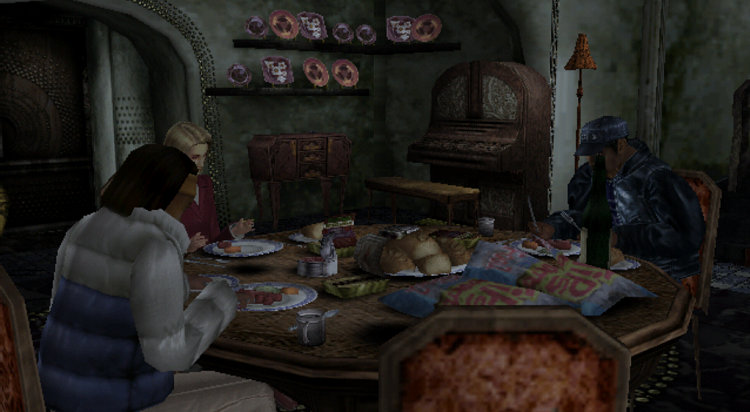
Mechanically, D-2’s adventure system is smooth, allowing you to pull up your inventory and use items on the person or point of interest you’re facing (if Laura doesn’t use it automatically, that is). However, the majority of these indoor sections do not contain puzzles at all, but are used instead for seguing into cinematics, or for information dumps. Late in the game, for example, Laura comes to an abandoned laboratory. Most of her time in the lab is shown via cutscenes, and when you are given control, all you are able to do is select from one of four information video segments connected to the lab’s tour system. Though the story and cinematics are expertly crafted, it seems like a wasted opportunity to have diminished the exploration and puzzle-solving aspects.
Unlike in D or Enemy Zero, there is the threat of danger even in these first-person scenarios. Though random encounters with enemies do not occur inside buildings, boss battles might. These play out the same way as other fights, with the player controlling Laura from a stationary first-person viewpoint, but the boss enemies are far quicker than run-of-the-mill foes and have considerably more health. Thankfully, D-2 allows you to save at any time (when not in the middle of a cinematic or fight), making it a considerably easier (and slightly less frightening) experience than its predecessors.
Another new feature is an in-game encyclopedia storing information about character, locations, and the plot as you progress, offering useful backstory. It’s something I didn’t pay much attention to when I first played the game, but in subsequent replays I have enjoyed perusing it. With Laura back to being completely mute, this information fleshes out her character a bit more, stitching the details of her predicament into a more rounded narrative.
Though the SEGA Saturn and other 32-bit consoles weren’t lacking in first-person, pre-rendered adventure games, the Dreamcast was, and D-2 is one of the few adventure games available on the system – if you can even classify it as an adventure game, that is. Either way, it’s fascinating to behold WARP’s move from pre-rendered to real-time graphics here. The amount of detail in the environments is astounding (for the time), and being able to search them so thoroughly gives the experience a deeper level of immersion than the studio’s previous efforts, even if it was ultimately mostly for world-building as opposed to puzzle implementation.
Conclusion
Taken together, this “trilogy” of WARP games represents a curious and little-known part of the horror game evolution in the 1990s that are scarcely mentioned in the same breath as their contemporaries of the time. No doubt that’s partly because they were seen as obscure console games, and partly because they didn’t neatly fit into any specific game style. Yet even now, if anyone could appreciate the style and innovation of Eno and his team, it’s adventure game fans.
Of the three games, the first is likely to be of most interest and is fortunately the easiest to find, as Nightdive Studios rereleased it as D: The Game on Steam and GOG on PC back in 2016. Its successors retained the common thread of first-person adventure-style exploration, but puzzles became increasingly less prominent from game to game in favour of more survival elements, though neither is a full-fledged action game so much as they are strange hybrids of mixed genre elements. Enemy Zero and D-2 aren’t nearly as easy to come by these days, but Dreamcast and Saturn games can be emulated now (a PC version of Enemy Zero was released on CD as well, though getting it running may be another hurdle), so for those interested in rarely explored corners of the horror game universe, there is certainly some fun to be had in seeking them out even today.

- Advertisement
- Help support AGH by advertising with us








1 Comment
Want to join the discussion? Leave a comment as guest, sign in or register in our forums.
Did a double-take seeing D on the front page today - fantastic job on the article Drew!
Reply
Leave a comment